Skip to content

What we do

Practise the moment that matters, before it happens

We build scenes for your training, whether it’s a workshop, an e-learning course or an induction: a room, people to talk to, things to notice and choices that are marked. It runs in a browser on our own engine, and reports to the client’s learning management system (LMS).

For consultancies, trainers and L&D teams whose training depends on people acting well under pressure. Our first example is insider risk.

Ask for a demoSee the examples

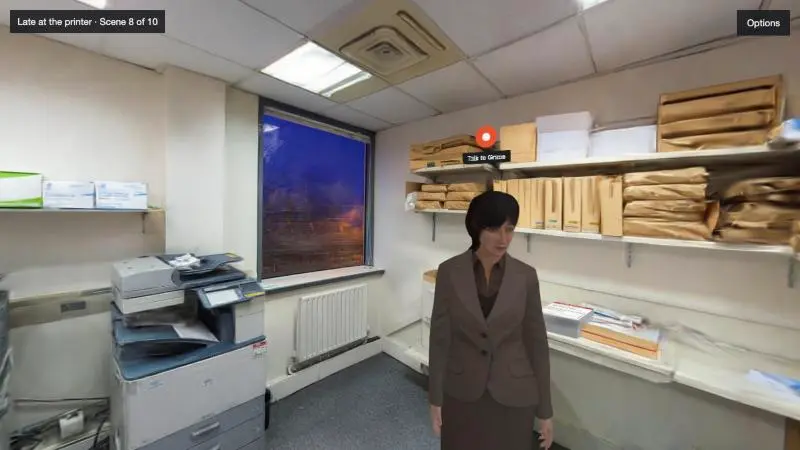
Grace from Finance standing in the print room late in the evening, a printer and shelves of paper behind her

Grace

“Oh! You made me jump. I didn’t think anyone else was still in.”

  • Why are you printing confidential papers at this time of night?
  • Sorry! You’re here late too. Long day?
  • Don’t worry, I won’t say a word.
One answer keeps things friendly and one is an accusation. Learners find out which at the end of the scene.
Tue 21:00

From our example module, set in a fictional office we built for the story. Yours can be set in your client’s own site.

Most training tells people what to do

Slides, videos and most e-learning explain the rules. They don’t give anyone practice at the awkward conversation, spotting what looks wrong, or turning down a request.

Our scenes let people rehearse that moment, and the result is recorded in the client’s LMS.

Set in your client’s own site

We have filmed 360 on location since 2015: inside a cave in Oman, at the Monaco Yacht Show and from drones. For training we can capture your client’s own site, so learners practise where they work.

360, filmed on location

Photographic. Good for scenes about looking and noticing.

A 3D room people walk round

The place scanned in 3D, with characters placed in it, so learners can walk round it as they would at work.

Confidential sites

For confidential sites we can scan and process everything on our own machines; ask us about it.

Two ways it can look

A fictional office we built for the story, or a real place, captured.

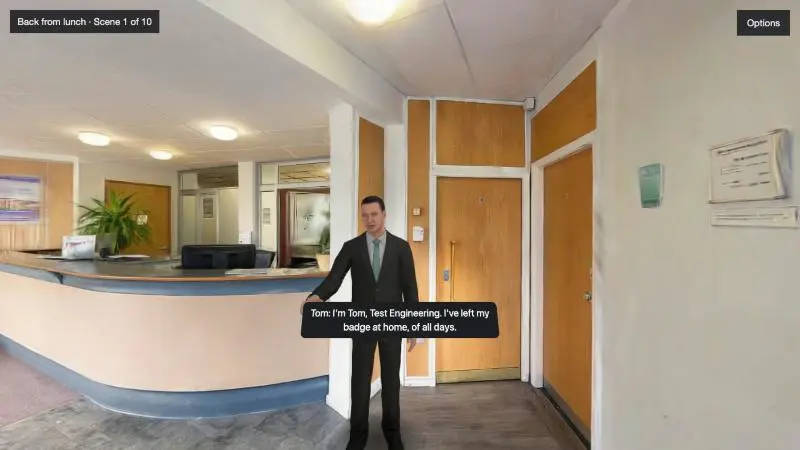
Tom from Test Engineering in reception by the security door, asking about his forgotten badge, with his line captioned below him
Insider risk: notice and report
Mon 13:30

A week in a fictional office, in eleven scenes, written from published UK guidance on insider risk: a colleague who wants to borrow your badge, a leaver’s last days, a device where it shouldn’t be, a late-night printer that turns out to be nothing, and a manager handling a concern from their team. It is our example, shown in demos.
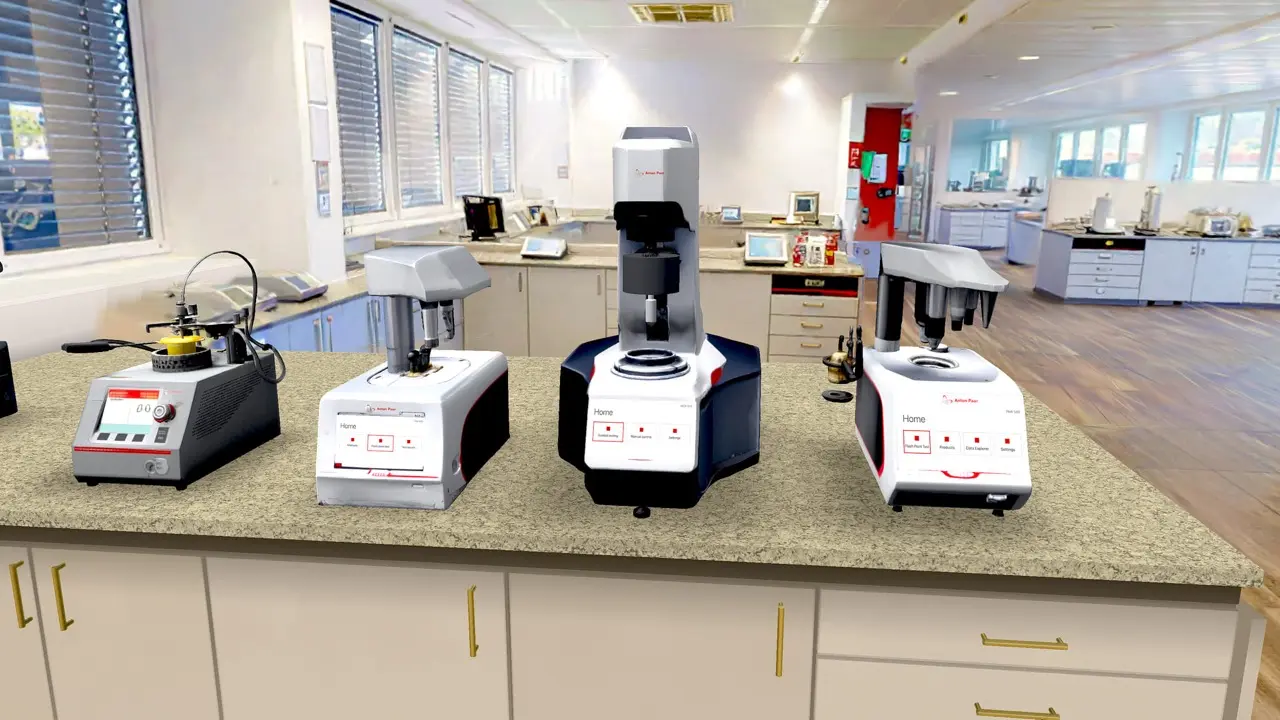
A captured working laboratory: four testing instruments on a bench in the foreground, benches and windows stretching back behind them
A real laboratory, captured

A working laboratory scanned into a 3D room people walk round, with a guide and the equipment to explore. The same approach suits induction and safety training.

Yours would be built from your method and subject, and can be set in your client’s site.

Training and induction we have worked on

Also 360 VR training videos for NHS Tower Hamlets, on anxiety, schizophrenia and suicide. Read the case study.

Your method, our studio

You keep your method and your client. We do the writing, the capture and the build, and we never reuse your script or method for anyone else. The work is led by Ben Huss, our founder.

  1. 01

    Discovery

    We go through your training, whether a workshop, an e-learning course or an induction, and pick out the moments people get wrong at work.

  2. 02

    Script

    We write the scenes from your method, in your words. You review every line before anything is recorded.

  3. 03

    Capture and build

    We film or scan the location, voice the characters and build the choices and observation tests.

  4. 04

    Pilot

    You run it with one client: inside your workshop, alongside it, or as a module in your e-learning course.

  5. 05

    Roll out

    It goes into your client’s LMS. Further modules can follow.

What is in a module

Our own engine

We build every module on the Immersi engine, which we develop ourselves. So when a scene needs something new, we add it, rather than working round an off-the-shelf tool.

Conversations with people

Learners talk to the characters in the room. Each choice changes how the conversation goes, and each is marked.

Observation tests

Learners have to spot what is wrong in the room before anyone points it out.

Feedback that explains why

At the end of each scene, learners are told why each choice was right or wrong.

Nothing to install

It runs in Chrome or Edge on an ordinary work laptop.

Results in the LMS

It reports completions and scores to your client’s LMS as a SCORM 1.2 package. xAPI is available, and is off unless the client turns it on.

Captions and keyboard play

Everything spoken is captioned, it can be played from the keyboard, and it works with a screen reader.

What your client receives

Working with us

With your client

Your client commissions a module built from your training, or added to a course you already sell, and we pay you a share of the fees.

Commissioned by you

You commission the module, and it is licensed to you to offer to your clients.

Direct

An organisation can commission a module from us itself. There is no Immersi server, account or tracking.

Questions

Do learners need a VR headset?
No. It runs in Chrome or Edge on an ordinary work laptop. Headset support is planned.
Can it be set in my client’s own building?
Yes. We film or scan the site ourselves, as 360 or as a 3D room people walk round. The scans belong to the client and are used only for their module.
Who writes the scenes?
We write them from your method and in your words. Nothing is recorded until you have signed off every line.
Do you reuse our material?
No. You keep your method, and we never reuse your script or method for anyone else.
Where are the results kept?
Completions and scores are recorded only in the client’s LMS. Run from an intranet or web server, it records nothing. No learner data comes to us.
Is it only for security training?
No. Our first example is insider risk, and the same approach suits any training where people must act well under pressure.

Have training people should practise, not just hear?

Tell us about your training and who it is for. We will show you the examples and talk through how yours would work.

Ask for a demoben@immersi.co.uk